
Treatment Guide
Can masseter Botox make the jawline sag?
If the masseter shrinks faster than the skin can adapt, jowling can become more noticeable. I review three published reports, the factors to assess before treatment and four options we discuss in consultation.

The key point
Masseter Botox reduces muscle volume, so planning should also consider the skin and the whole facial contour. Published cases describe jowling, but its mechanism and recovery are not fully established. Review elasticity, existing sagging and muscle size before deciding on the dose, timing or whether to treat.
- Jowling after masseter Botox has been reported; rapid volume reduction can also affect people in their twenties.
- Assess skin elasticity, existing jowls, muscle size, dose and treatment intervals together.
- Discuss lifting before or alongside treatment, a smaller staged dose, or taking a break from masseter Botox.
Why can sagging happen?
I’m Dr. Sijin Park, director of Layer Clinic in Apgujeong. “Can masseter Botox make the lower cheeks or jawline sag?” This may surprise patients, but it can happen.
People who began treatment in their early twenties may not notice it because their skin still has good elasticity. As elasticity declines in the thirties, and especially after forty, changes around the jawline may become more apparent. Age alone, however, does not determine the outcome.
Imagine a tightly fitted knitted sweater you have worn for many years. It has stretched to fit your body. If your body suddenly becomes smaller, an old sweater that has lost its elasticity may hang loosely and sag. A new sweater may spring back and fit snugly again.
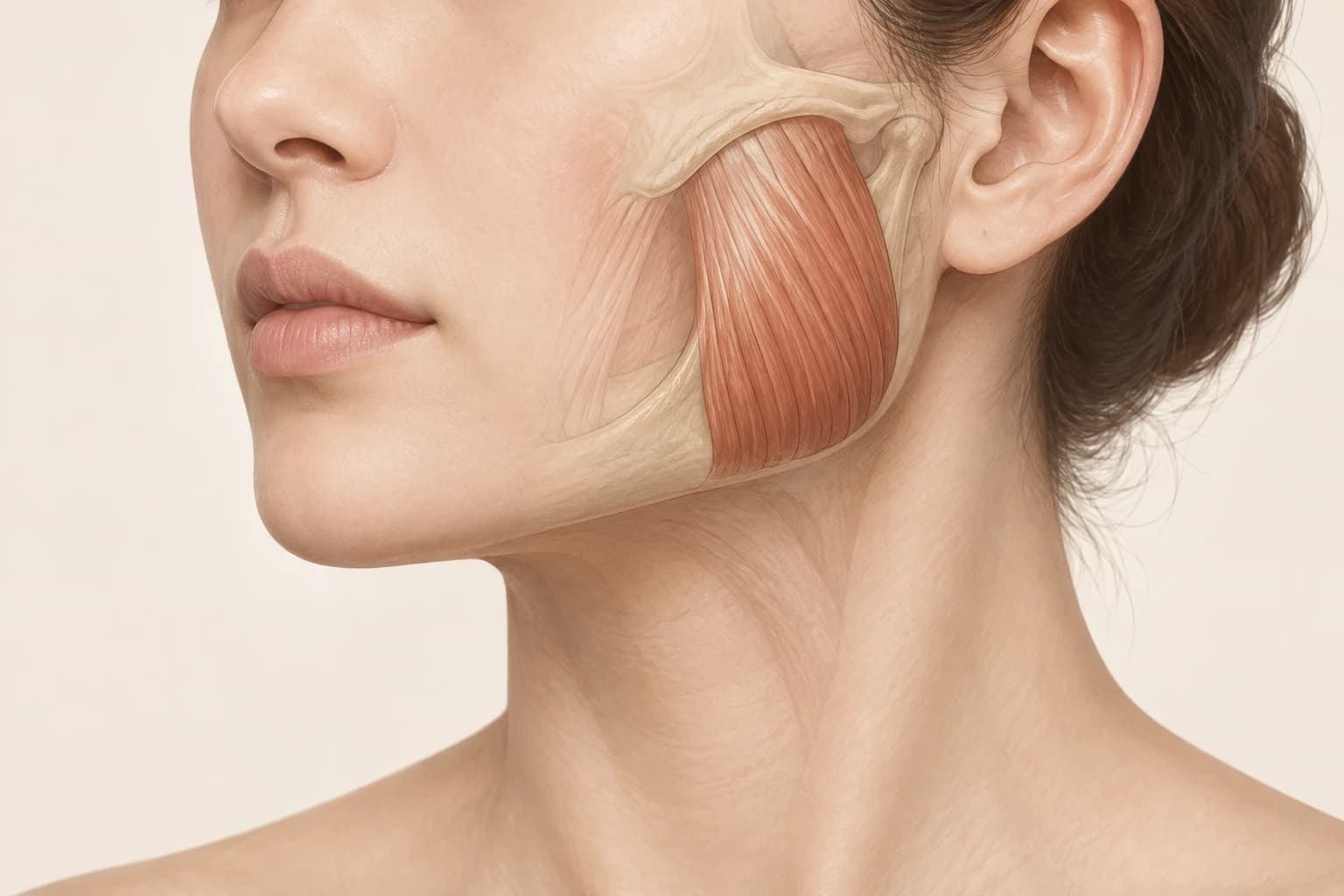
In this analogy, the body is the masseter—the chewing muscle—and the sweater is the overlying skin. Skin that has accommodated a large masseter needs to adapt when the muscle becomes smaller. Elastic skin may keep up; skin with less elasticity, or a very rapid reduction in volume, may leave the skin and soft tissues looking looser. This is a proposed explanation for reported cases, rather than a proven explanation for every instance of sagging.
Cases from three published reports
Is this only a change in how someone perceives their face? I looked at three publications from different countries and years that describe actual jowling after treatment. None was designed solely to investigate recovery from post-treatment sagging, so we need to read both the cases and the limitations.
Australia, 2008: Liew & Dart
Nonsurgical Reshaping of the Lower Face compared treatment in 34 Western patients and 48 East Asian patients. The Western group showed improvements in lower-face contour and bruxism symptoms with a lower initial dose.
A 50-year-old woman who already had mild jowls felt that they worsened during the first two months after her initial injection. The authors recorded subsequent improvement as the skin and soft tissues accommodated the new contour. It was a complication observed within a study of facial reshaping.
Singapore, 2010: Woffles Wu
Botox Facial Slimming/Facial Sculpting describes the author's experience treating more than 600 patients since 1998. It explains that a high dose over a short period can reduce muscle volume faster than the skin can accommodate.
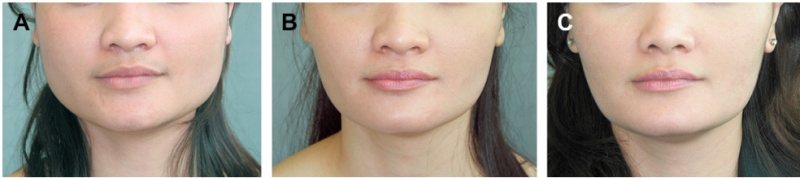
One case was a 28-year-old woman with very large masseters. She received 60 units per side in the first month and 40 units per side in each of the next two months. Her lower face reduced rapidly in volume and mild jowling appeared. She then received 40 units every four to six months. At the three-year follow-up, the skin was described as fitting the new contour without jowling.
This is a published case, not a Layer Clinic treatment result. The amounts and intervals describe that case; they are not a recommended regimen for an individual reader. The point I want to highlight is that being in your twenties does not eliminate the possibility of sagging after a rapid, high-dose reduction in volume.
Taiwan, 2018: Peng & Peng
Complications of Botulinum Toxin Injection for Masseter Hypertrophy followed 2,036 treatment sessions in 680 patients. Its public abstract reports sagging after four sessions, or 0.20% of sessions. That rate cannot simply be treated as an individual patient's probability.
The cases I reviewed describe patients aged forty or older and highlight prominent cheekbones in middle-aged patients who developed sagging after a standard dose. In a later explanation published that year, the study author also describes sagging as occurring mainly after forty, with overly rapid muscle atrophy as a possible cause: the skin may not have enough time to adapt.
My takeaway from these publications is that jowling after masseter Botox can occur. A mismatch between muscle reduction and skin adaptation is a plausible explanation, but these reports do not establish every cause or predict everyone's recovery.
Factors to assess before treatment
Rather than simply fearing the procedure, reviewing the following factors can help us decide whether and how to treat:
- Reduced skin elasticity, including changes that may appear in the thirties or forties and beyond
- Mild jowls already present before treatment
- A facial shape with prominent cheekbones
- High doses concentrated over a short period
- Very large masseters, with a substantial volume that could be reduced
These are factors I have drawn together from reviewing the literature and its cases. Having one does not mean sagging is inevitable, and youth does not mean there is no risk.
Four options to discuss
Masseter Botox does not need to be avoided in every case. The important question is how to tailor the plan to the skin—or whether to skip it this time. I review age, elasticity, existing sagging and muscle size with patients and discuss these options.
1. Address laxity with lifting before masseter Botox
This is like addressing the looseness of the knitted sweater first. We consider skin elasticity and sagging before reducing the muscle. It does not mean that everyone needs lifting or that lifting is guaranteed to prevent jowling.
2. Combine lifting with masseter Botox
When both a bulky masseter and sagging are concerns, we can consider addressing muscle volume and skin condition alongside each other. Whether to combine treatments, and in what sequence, depends on the face we are assessing.
3. Use a smaller dose and stage treatment
Instead of automatically repeating the dose used in your twenties, we can adjust the pace of muscle reduction with smaller, staged treatments. The aim is to allow time for the skin to accommodate; dose reduction and multiple sessions are also discussed in the literature.
4. Do not treat, or take a break
If the masseter is not large but treatment has become a habit, or if lower-cheek sagging is already pronounced, taking a break may be the more appropriate choice.
With any plan, accurate injections at several points within the masseter's anatomical safety zone are fundamental. Injection position and depth matter alongside the dose.
What if jowling has already appeared?
The publications include cases in which sagging improved as the skin adapted over time. They were not studies designed specifically to establish recovery from this complication. More research is needed to know whether everyone improves, how much, and when.
Even if a change eventually improves, living with it in the meantime can be distressing. I would review a smaller dose or a pause before simply repeating the next treatment, and discuss lifting if the skin's condition makes it appropriate. Neither a recovery date nor a lifting result can be promised for everyone.
A square jaw is only the starting point
Before treating “a square jaw” as a straightforward reason for masseter Botox, ask what actually creates the outer contour of your face. How large are the masseters? Are jowls already present? How elastic is the skin?
I believe planning should assess the whole face rather than muscle reduction alone. The decision to treat, the dose and the timing should follow that assessment. Consultation starts with finding the option that suits your face now, rather than repeating a familiar procedure automatically.
References and case sources
- Liew S, Dart A. Nonsurgical Reshaping of the Lower Face. Aesthetic Surgery Journal. 2008;28(3):251–257. DOI.
- Wu WTL. Botox Facial Slimming/Facial Sculpting. Facial Plastic Surgery Clinics of North America. 2010;18(1):133–140. DOI. The 28-year-old patient's case is described in Figure 3.
- Peng HP, Peng JH. Complications of Botulinum Toxin Injection for Masseter Hypertrophy: Incidence Rate from 2036 Treatments and Summary of Causes and Preventions. Journal of Cosmetic Dermatology. 2018;17(1):33–38. DOI.
- Peng HP. Masseter Hypertrophy: Toxin Treatment Techniques, Causes of Complications, and Prevention. 2018. Author's later explanation.
This column shares Dr. Park’s clinical perspective. It is not an individual diagnosis or a guarantee of treatment results; suitability and risks are discussed in consultation.
What does this mean for your skin?
Tell us about your concerns and treatment history. Your doctor can discuss the options with you.
Ask on WhatsApp