
Treatment insights
Re2O updates: adverse effects, injection methods and energy device combinations
What I took from a Re2O conference: vascular complications, nodules and immune reactions, plus injection planes and RF/HIFU combinations. Published findings and early discussions need to be read differently.

The key point
Recent Re2O discussions include promising directions as well as unresolved safety questions. A reported vascular complication means treatment cannot be assumed to be free of risk. Injection methods, immune reactions, energy device combinations and long-term outcomes all require further study.
- Understanding vascular complications, nodules and immune reactions, and the limits of long-term safety data
- Why four injection methods and treatment across several layers are being discussed
- What a conference presentation on RF/HIFU combinations does—and does not—establish
What was discussed at the conference?
I’m Dr. Sijin Park, director of Layer Clinic. After attending a Re2O conference, I wanted to write down the latest discussions while they were fresh in my mind. Humedix and L&C BIO were introducing Re2O V, with lectures and a question-and-answer session on Re2O beforehand.
The topics that especially caught my attention were adverse effects, injection planes and methods, and combinations with energy-based devices, or EBDs. This article includes both published cases and experiences or hypotheses shared at the meeting. These are still developing areas of research; my aim is to explain the direction of current discussion.
Re2O uses particulated human acellular dermal matrix, or phADM. Reports of few major problems in limited studies or conference experience do not establish that it is risk-free. In particular, a vascular complication with residual scarring has been reported, so an absence of adverse effects should not be assumed.
A vascular complication beginning after 48 hours
A case report published in July 2026 describes forehead pain, itching, redness and pustules beginning about 48 hours after Re2O injections to the forehead and both cheeks. The patient had initially reported no symptoms. The product was reportedly prepared with normal saline and non-cross-linked hyaluronic acid (HA), but the actual injection method, including whether a needle or cannula was used, and the preparation process could not be verified.
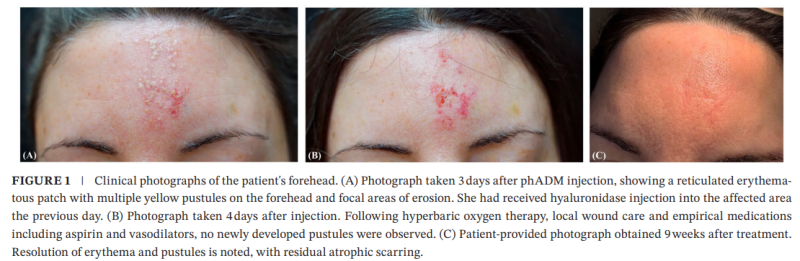
Symptoms persisted after an initial hyaluronidase injection. They subsequently improved with hyperbaric oxygen therapy, local wound care and medications intended to support blood flow. Formal clinical follow-up was discontinued; a patient-provided photograph at nine weeks showed residual atrophic scarring. This was therefore not a report of complete recovery, and the longer-term outcome was unknown.
The two symptom-free days stand out compared with the immediate or early signs typical of filler-related vascular complications. The authors discussed whether, beyond physically obstructing a vessel, collagen and fibronectin in the material might promote platelet adhesion and aggregation, prolonging thrombosis and impaired blood flow. The mechanism remains a hypothesis.
Unlike HA filler, phADM itself is not dissolved by hyaluronidase, and a specific agent to dissolve phADM has not been established. The treatment above is an overview of the clinicians’ management of this case, rather than a universal treatment protocol or a method to follow at home.
Reference: Sung SW, Lee SY, Seok J, Kim BJ. Vascular Complication Following Injection of Particulated Human Acellular Dermal Matrix: A Case Report. Journal of Cosmetic Dermatology. 2026;25:e71049.
The discussion around nodules
Nodules are an important concern with collagen boosters such as Juvelook, Radiesse and Sculptra. Re2O should not be assumed to be entirely exempt from that concern. At the conference, speakers described no severe nodule cases reported over roughly two years of use since launch, with many nodules improving over time. This does not establish their long-term incidence or risk.
Approaches discussed included mechanically dispersing a lump using an aqueous solution such as sterile water and lidocaine, and, in selected circumstances, hyaluronidase. Speakers also shared experience suggesting that heating, including RF, had offered little benefit. These comments about hyaluronidase do not mean it dissolves phADM itself; management depends on the cause and condition of the nodule and requires clinical assessment.
For injection technique, the discussion emphasized dividing treatment into very small droplets rather than placing a large bolus, particularly under the eyes. Injection across planes such as above the periosteum and beneath the skin, while excluding the superior SOOF, an under-eye fat compartment, was also mentioned. These are approaches discussed at the meeting, rather than methods proven to prevent nodules reliably.
Immune reactions, including swelling
Speakers also described immune reactions, including swelling, beginning immediately or within several days of treatment. They were described as uncommon, but no aggregated incidence data were presented, so a precise frequency cannot be given.
One hypothesis was that reactions could be more likely in areas previously treated with filler. The causes remain insufficiently studied, and this particular hypothesis has not been validated.
Management discussed included corticosteroids and antihistamines according to the clinical situation. Preventive corticosteroids and appropriate spacing between treatments, particularly under the eyes, were also mentioned as potentially helpful. These suggestions should not be treated as established general prevention measures; medication decisions require individual clinical assessment.
There are also insufficient accumulated data on the patterns and frequency of long-term complications. This is one reason I think it is important to keep studying newly reported cases.
Injection planes and four delivery methods
Different injection tools are discussed in relation to different target planes and clinical aims. The comparison below reflects the categories presented at the conference. It is not a guide for patients to choose an injection depth or device.
Needle-free jet injector
Discussed target plane: Papillary and upper reticular dermis. Discussed clinical aim: Texture and tone.
DermaShine (presentation notation: 0.2–0.3 mm)
Discussed target plane: Papillary to reticular dermis. Discussed clinical aim: Density and elasticity.
Needle
Discussed target plane: Deep dermis to subdermis. Discussed clinical aim: Focal wrinkles and scars.
Cannula
Discussed target plane: Subdermal or immediately subdermal plane. Discussed clinical aim: Broad dispersion and tissue support.
The discussion included treating several layers, for example a three-layer injection technique. There is a theoretical rationale for targeting different planes, but the actual benefit of multilayer treatment and the suitability of each approach require further study.
Product loss when using DermaShine
During the question-and-answer session, someone asked whether product leaked behind the needle cap. The response was that such leakage does occur, with a recommendation to replace the cap after using 2–3 mL. I do not use DermaShine, but this was something I had wondered about. It is a conference response acknowledging possible product loss, rather than a verified general instruction for operating the device.
Combining treatment with RF or HIFU on the same day
A conference presentation reported that tissue examination after hADM injection followed by needle RF, RF or HIFU on the same day showed no denaturation or gelatinization. A possible synergistic effect was also suggested.
However, I could not find the corresponding paper. I therefore share this as a direction presented at the meeting, not as proof that same-day combinations have established safety or efficacy. A tissue finding alone would not establish overall clinical safety either. This is an area for further research.
How I view the evidence
I view the potential of hADM products such as Re2O positively. The experiences shared at the meeting and observed effects make this an area of interest, but they do not support a promise that every patient will have the same result.
I tend to be cautious with any procedure. I believe an interest in a new product must go together with keeping adverse effects in mind. I will continue to study vascular complication reports, the gaps in long-term data, and the unanswered questions about injection methods and combined treatments.
This column shares Dr. Park’s clinical perspective. It is not an individual diagnosis or a guarantee of treatment results; suitability and risks are discussed in consultation.
What does this mean for your skin?
Tell us about your concerns and treatment history. Your doctor can discuss the options with you.
Ask on WhatsApp